|
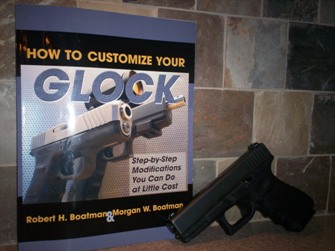
The book is broken down into four main
sections, with each successive section
detailing categories of modifications
requiring modestly increasing
disassembly/reassembly skills. Fear not
however! Practically speaking, you don’t
need either three hands or any other
superhuman aptitude to modify your Glock
with drop-in parts. Likewise, you won’t
need to take out a second mortgage on your
home in order to buy the necessary tools.
It is much easier than you think if you take
a cue from the carpenter’s sage advice of
“measuring twice and cutting once”. In this
case, read the book cover to cover and
digest its information. Then, re-read the
applicable section(s) you’re interested in,
ensuring you thoroughly understand the
process BEFORE you take apart your gun. The
Boatman’s easy writing style puts otherwise
dry, technical prose into easily
understandable layman’s terms.
The first section deals with modifications
which can be made with no disassembly of the
pistol (after properly checking to ensure
that the piece has both an empty chamber and
an empty magazine well). The second section
deals with modifications which require a
basic field strip of the pistol, such as
when cleaning. The third section deals with
modifications which require detail stripping
the slide. The fourth section discusses
those modifications which would require
detail stripping the frame. The pages are
chocked full of excellent pictures of the
disassembly/reassembly procedures along with
a good overview of the simple tools needed
to break the average Glock down into it’s 30
or so component pieces. There is also a
very good section regarding the disassembly
of Glock magazines for both cleaning and
replacement of any sub-component parts.
The subject matter of this book particularly
resonated with me as several years ago I had
modified a couple of components in my Glock
model 23 so as to increase its reliability
and sights. I replaced the OEM coiled steel
factory trigger spring with one of Glock’s
polymer and spring steel New York 1 (NY-1)
trigger springs so as to both markedly
strengthen what is sometimes regarded as a
weak link in the basic design of the Glock
firing mechanism and to provide a smoother,
albeit slightly heavier, trigger stroke. To
offset the heavier trigger pull it produced
I replaced the factory 5.5 lb. disconnector
with an aftermarket 3.5 lb. disconnector.
This combination, while increasing trigger
spring longevity over the basic trigger
spring set up also provided a smoother
DA-only trigger stroke and “snappier”
trigger reset after the shot breaks. The
Boatman’s speak to this type of modification
specifically in their work and it is well
worth reading. I also replaced the factory
plastic recoil spring guide rod with a
one-piece metal rod to eliminate the
possibility of the recoil spring kinking
during the slide cycling sequence and lastly
I switched out the OEM plastic
non-luminescent sights with a set of Glock’s
fixed, metal luminescent ones.
My experience is that with these basic
modifications I have, to some degree,
improved the integrity and longevity of the
firing mechanism, while smoothing up the
trigger stroke and getting faster trigger
resets. Additionally, the installation of
the one-piece guide rod with the factory
spring held captive aids in smoothing things
up a bit by way of the slide cycling.
Lastly, the installation of Glock’s factory
metal, fixed, night sights rounded out what
I felt was needed to make the pistol
appropriate for defensive use night or day.
With a mixture of several thousand rounds of
factory FMJ and JHP down the tube to date,
I’ve had no failures to feed, fire and eject
with the pistol, and I like the smoother
trigger stroke, faster trigger reset as well
as the sight picture provided by the night
sights. I feel as though my experience
during and after the fact of modifying my
G23 reinforces the central tenets of the
Boatman’s excellent book in that I can
categorically say that the basic reliability
enhancements they discuss work well and
complement the Glock’s basic robust design.
By way of an objective book review the only
points that I could make in possibly
improving the book in subsequent editions
would be for it to be spiral-bound so as to
lay flat when you’ve got it out and you’re
working on your gun. I think most how-to
books of this type, or reloading manuals for
that matter, should be spiral bound for ease
of use when working at the bench or table.
This recommendation is more directed to the
publisher, and is just my two cents…
Additionally, and at the risk of sounding
like some Ralph Nader-ish OSHA type, I would
include verbiage recommending that users
should wear safety glasses when
disassembling a spring loaded assembly on
any gun. Having first-hand experience with
disassembling an M14 bolt by hand, I have
immense respect for the energy contained in
that bolt’s compressed ejector assembly.
Working with springs and small parts simply
requires one to wear glasses for safety’s
sake. This is a minor criticism for sure,
as I would venture that most responsible
firearm owners implicitly understand the
need for, and do take, proper eyewear
precautions when both shooting, working on
their guns or reloading.
All in all, this book would hands-down be a
worthwhile addition to any Glock owner’s or
enthusiast’s collection as it is a well
thought out and well written manual on
enhancing one of the most influential and
seminal handgun designs of the last 25
years.
For additional information regarding the
book How to Customize Your Glock
(Step-by-Step Modifications You Can Do at
Little Cost) by Robert H. Boatman &
Morgan W. Boatman please go to Morgan
Boatman’s website:
www.customizeyourglock.com. Additional
information, reader testimonials, and photos
of the book can be found there.
Biographical information on the Boatman team
authors can also be found, in addition to
information on their other firearm-related
books. You can purchase a copy of the book
in this review directly from the website for
$19.95 + shipping. Alternately, you can
also purchase a copy of the book directly
from the publisher, Paladin Press of Boulder
Colorado. Paladin Press can be contacted
via their website at
www.paladin-press.com, or by calling
them at (800) 392-2400 to place a credit
card order by phone. |